Auditing a Perfume OEM Manufacturer: Questions That Produce Evidence
Supplier audits fail for a predictable reason: the buyer asks questions that invite reassurance instead of evidence. Can you make this? Yes. Do you have quality certification? Yes. Six months later the artwork is still circling because nobody verified scope, capacity or who signs a deviation. The fix is procedural rather than clever — ask for documents, ask what they cover, and ask what happens when something goes wrong.
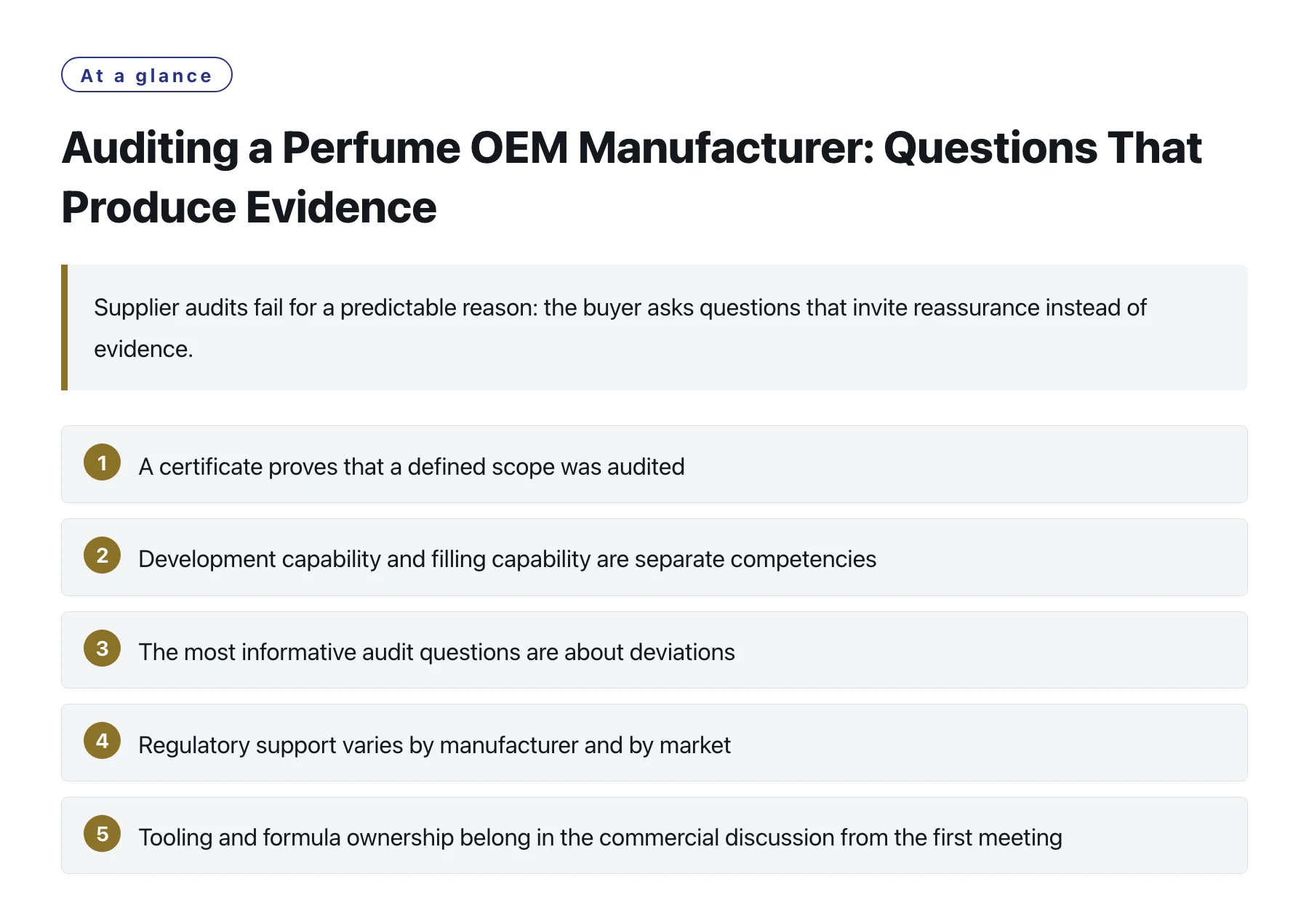
Key takeaways
- A certificate proves that a defined scope was audited, not that every product or line is covered by it, so the scope document matters as much as the certificate.
- Development capability and filling capability are separate competencies, and a supplier can be strong in one and thin in the other.
- The most informative audit questions are about deviations, rework and rejected batches rather than about strengths.
- Regulatory support varies by manufacturer and by market, so name the markets you intend to sell in and ask what is prepared in house.
- Tooling and formula ownership belong in the commercial discussion from the first meeting, not in a later renegotiation.
Almost every brand audits its first supplier the same way: a tour, a slide deck, a certificate folder and a quotation. Those four things answer the easy half of the question and leave the expensive half untouched.
A useful audit is less about whether the supplier is good and more about whether the supplier is a match: the right formats, the right volume band, the right documentation for your markets, and a working process for the disagreements that will certainly happen.
What follows is a checklist organised around evidence. Each row in the table below is a question you can ask in a single meeting and get a verifiable answer to.
Five capability areas and the answers that separate suppliers
| Capability area | What to ask for | A weak answer sounds like | A strong answer sounds like |
|---|---|---|---|
| Quality systems | The certificates, their scope statements and the issuing bodies, plus the most recent audit findings | A folder of certificates with no scope pages and no corrective actions | A named standard, a defined site and scope, and a description of how non-conformities are closed |
| Development and perfumery | How briefs are handled, who does the creative work, how many evaluation rounds are normal | We can make any fragrance you describe | A defined briefing form, an internal or partner perfumery team, and a described sample approval loop |
| Filling and format range | Which formats run in house, which volumes the line handles, which steps are subcontracted | Everything is possible | A specific format list, stated filling methods and an honest list of outsourced steps |
| Documentation and market support | Which market dossiers, assessments and notifications the supplier prepares, and which the brand must file | We provide all documents | A market-by-market split of responsibilities, with examples of what has been prepared before |
| Commercial durability | Minimum order quantities, tooling ownership, formula ownership and what happens at the end of the relationship | We will sort that out when we get there | Written terms for ownership, tooling transfer and the treatment of a repeat order smaller than the first |
The third column is what most buyers hear, and the fourth is what they should be listening for. Neither answer requires the supplier to be large; it requires the supplier to know its own boundaries. A factory that can describe what it does not do is usually easier to plan around than one that agrees with everything.
Running the audit in a single day
- Send the questionnaire before the visitAsk for the certificate scope statements and the format list in advance, so the meeting is spent on discrepancies rather than on dictation.
- Walk the filling and packing areaLook at the line, the changeover practice and how components are stored, because those reveal more about consistency than a meeting room does.
- Visit the laboratory or the sampling benchAsk how a sample is prepared, retained and compared, which is where odour approval either has a method or does not.
- Ask three questions about failureRequest an example of a rejected batch, a deviation and a customer complaint, and ask what changed afterwards.
- Name your markets and check the paperwork splitState where you intend to sell and confirm, in writing, which documents the supplier prepares and which the brand must file.
- Write the audit note the same weekRecord what was verified, what was promised and what remains open, then send it to the supplier for confirmation while memories are fresh.
What certificates actually prove
Certificate folders create a false sense of completion. A certificate is a statement about a defined management system, at a defined site, assessed on a defined date. Knowing the scope is what turns the document into information.
Independent testing and certification organisations publish what their cosmetics schemes cover, which makes it possible to check whether the certificate in front of you addresses the thing you are worried about [1].
Scope and site, not just the logo
Two certificates for the same standard can cover very different activities. Ask which site was audited, which product categories are included, and whether filling, packing and warehousing fall inside the scope or outside it.
If the certificate covers a site you will not be using, say so in the audit note. It is not an accusation; it is a record that the evidence applies somewhere else.
A quality standard is not a GMP standard
A general quality management standard and a cosmetics good manufacturing practice standard answer different questions. One addresses how an organisation manages processes; the other addresses hygiene, contamination control, batch records and product safety specifically. A supplier that holds both is not twice as good, but it is auditable on two fronts.
Sector bodies such as Cosmetics Europe work on industry guidance and standards for cosmetics manufacturers, which is a useful reference when you want to know what a claim about good manufacturing practice is supposed to mean [2]. For fragrance specifically, the International Fragrance Association is the body that publishes the material standards the industry works to [3].
Market rules sit outside the certificate
Certification does not place a product on a market; regulation does. Markets differ, and the differences are administrative as well as technical. Canada, for example, requires cosmetics to be notified and applies its own ingredient requirements, with the details published by the health regulator [4].
This is why the audit should include a market list. A supplier that has prepared dossiers for your target markets before will shorten your launch, and one that has not is not disqualified — it just means the work sits with you.
Three answers should send you back to the documents rather than forward to a quotation. The first is a certificate offered without a scope. The second is a development timeline given without any question about your volume band, because it means the supplier has not yet thought about whether your order fits its line. The third is enthusiasm about a bespoke bottle with no mention of tooling cost or lead time. None of these is proof of a bad supplier — every factory has account managers who answer quickly and check later. They are simply the points where you should ask for the file, the schedule or the mould, in writing, before you plan around the answer.
Turning an audit into a shortlist
An audit produces findings, not a ranking. The last step is deciding which findings matter for the product you are actually launching, and which are tolerable at your current size.
A supplier that is excellent for a first run may become awkward at scale, and a supplier built for volume may find a small first order unattractive. Both are legitimate; only one fits your plan.
Fit beats size
The qualification questions are much the same wherever you buy, but a perfume OEM manufacturer in China adds a language, time-zone and travel dimension to every answer you receive, and that is worth pricing into the decision alongside the unit cost.
Compare suppliers on how they handle the parts of the project you find hardest, not on the parts you have already solved. A brand with a strong design team should weight manufacturing consistency; a brand with a strong technical team should weight development support.
Check commercial durability
Ask what happens if the second order is half the size of the first, whether tooling is charged once or per run, and how a price change is handled. Suppliers that answer these plainly tend to be the ones that survive a difficult quarter.
For reference, manufacturers such as Xuelei in Guangzhou publish that they hold ISO 22716, GMPC, ISO 9001, ISO 14001 and ISO 45001 and meet HALAL requirements; a published claim like that is a starting point for verification, not a substitute for it.
Agree the exit before you need it
Specify what happens to the formula, the moulds and the retained samples if the relationship ends. That conversation is easy at the beginning and almost impossible in the middle of a dispute.
An exit that both sides consider fair is not pessimism. It is the reason a supplier can be trusted with a project that matters.
Sources
- SGS: Cosmetics, Personal Care & Household Testing —— Testing, inspection and certification services for cosmetics and personal care, including microbiological, stability and safety testing aligned with cosmetics GMP.
- Cosmetics Europe —— The European trade association for the cosmetics and personal care industry, publishing guidance, positions and market information.
- International Fragrance Association (IFRA) —— IFRA is the global trade association of the fragrance industry; its site publishes the IFRA Standards, positions and science on the safe use of fragrance materials.
- Health Canada: Cosmetic Safety —— Health Canada's cosmetics pages, covering cosmetic notification, the ingredient hotlist and safety requirements for cosmetics sold in Canada.
Frequently asked questions
Which certificates should a perfume manufacturer hold?
At a minimum, look for a cosmetics good manufacturing practice certificate such as ISO 22716, plus the quality and environmental standards relevant to your market. Ask for the scope statement of each certificate as well as the certificate itself, since scope defines which activities and sites were actually assessed.
Is ISO 9001 enough for a fragrance supplier?
It covers quality management but not cosmetics-specific manufacturing practice. Hygiene, contamination control and batch traceability for a cosmetic product are addressed by GMP standards, so a supplier holding only a general quality certificate leaves part of the picture unverified.
How do I verify that a manufacturer really runs the lines it claims?
Visit, or request a live video walkthrough of the filling area, the laboratory and the warehouse. Ask which formats run in house and which steps are subcontracted, then confirm the answers in writing. A factory that can describe its boundaries is easier to audit than one that claims every capability.
What should I ask about tooling and mould ownership?
Ask who pays for the mould, who owns it, and whether it can be transferred to another manufacturer if the relationship ends. Brands that fund tooling can often negotiate ownership or a transfer option; suppliers who tool at their own cost usually keep it. Get the answer in the development agreement.
Does buying from a manufacturer in China change the compliance work?
The obligations that apply in your market do not change, but who prepares each document might. Some manufacturers prepare assessments and dossiers for particular markets while others supply technical data only. Confirm the split by market in writing before the project starts.