A Practical Guide to Managing Supplier Communication Across Time Zones
When buyers and suppliers work across time zones, a missed handoff can delay a sample, approval, production hold, or shipment decision. A practical system defines response windows, urgent contacts, controlled records, and owners for the next action. The goal is a predictable project rhythm, not constant availability.
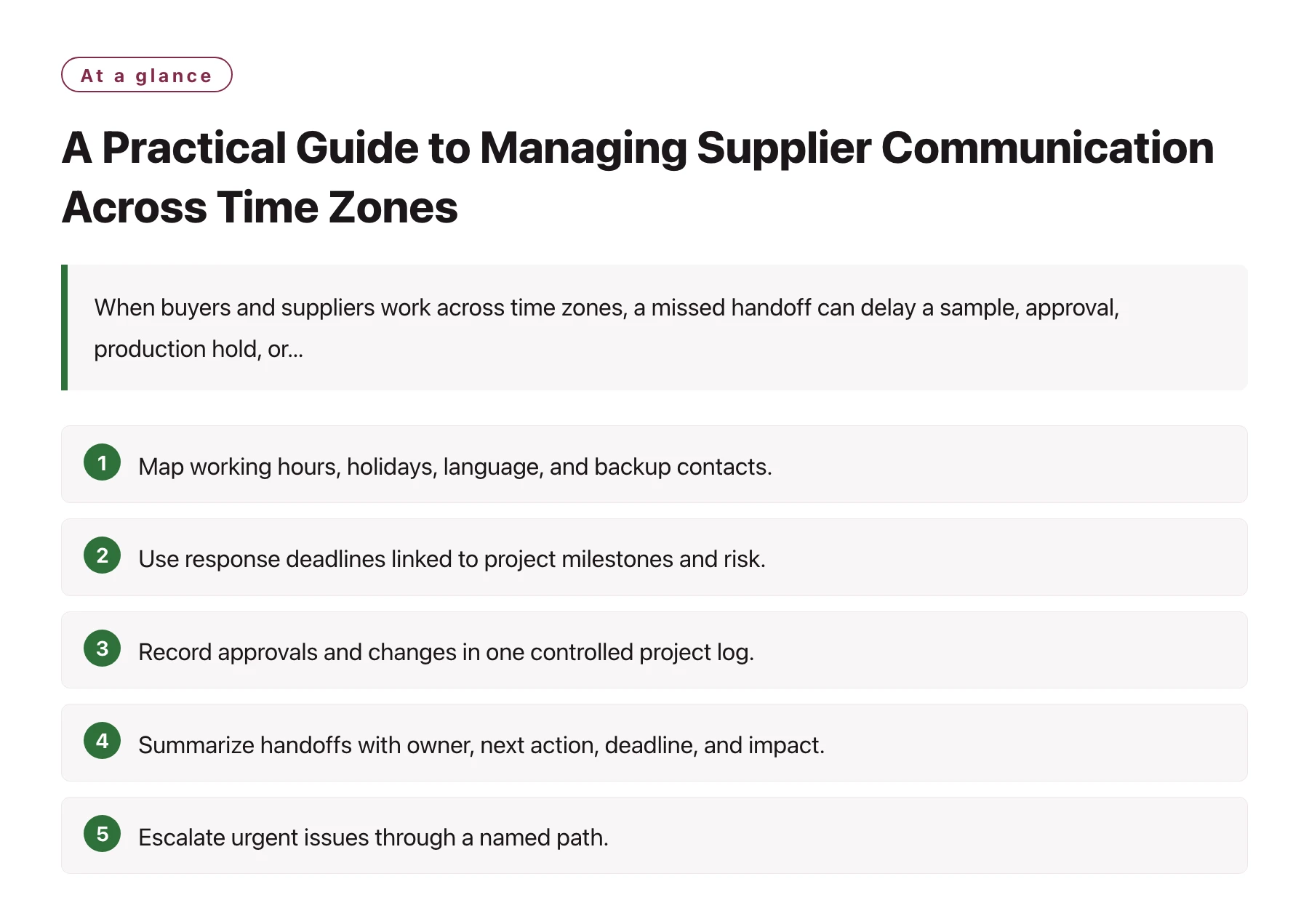
Key takeaways
- Map working hours, holidays, language, and backup contacts.
- Use response deadlines linked to project milestones and risk.
- Record approvals and changes in one controlled project log.
- Summarize handoffs with owner, next action, deadline, and impact.
- Escalate urgent issues through a named path.
Keep project requirements, supplier commitments, installation plans, and handover records connected.
1. Map the teams and working windows
List buyer, supplier, factory, quality, engineering, logistics, and regulatory contacts with location, time zone, language, working hours, and backup. Identify which roles must be available for sample approval, defect escalation, and shipment release.
Agree overlapping hours for recurring meetings and define quiet hours. Account for local holidays and shift schedules. Do not assume a sales contact is available to make technical decisions or reach production after hours.
2. Set urgency and response expectations
Classify routine questions, milestone-critical requests, and urgent safety, quality, or shipment issues. Set a response target for each class and identify the communication channel. Define when a missed response triggers a reminder or escalation.
A response target is not a promise to solve the issue instantly. Ask the receiver to acknowledge the request, name the owner, and provide an expected answer time. This keeps an unanswered message from appearing resolved.
Use a decision matrix to show who recommends, reviews, approves, and must be informed for each decision type. When a primary approver is unavailable, name an authorized delegate and record any limits on that delegation. This avoids waiting on the wrong contact or accepting an unauthorized change.
3. Use reliable timestamps and records
Write dates with an unambiguous format and include the time zone for deadline-sensitive requests. Identify the product, order, revision, and file in each message. Keep controlled specifications, approvals, reports, and quotes in an agreed shared location.
ISO 9001:2026 sets quality management system requirements; use supplier process evidence to understand documented communication and control, while defining project-specific channels, response times, and approval rules in the order. [1]
4. Make written handoffs complete
At the end of a workday, summarize completed tasks, pending questions, risk, owner, due date, and who is expected to act next. Link the current document revision rather than attaching another uncontrolled copy.
For a critical handoff, ask the next owner to acknowledge receipt and repeat the needed decision or hold condition. Do not rely on an emoji, read receipt, or partial reply as approval of a product change.
5. Schedule meetings with a decision purpose
Use recurring calls for coordination issues that benefit from discussion, such as schedule recovery, sample review, or process changes. Share agenda, current documents, and required attendees in advance. Reserve time for decisions and owners, not only status updates.
Send minutes with decisions, open issues, owners, deadlines, and next meeting. Record disagreements or assumptions clearly. If a technical approver was absent, mark the decision pending until they respond through the controlled channel.
6. Protect technical meaning across languages
Use consistent product terms, units, date formats, and approved translations. For safety, quality, or commercial clauses, have a qualified bilingual reviewer confirm meaning. Keep the controlling language and document revision clear.
Avoid shorthand when discussing tolerance, deviation, lot, shipment release, or due date. Provide annotated drawings or examples when a word may carry different meanings for the buyer and factory.
7. Escalate problems before they cross a time-zone gap
For a risk, state evidence, affected product or quantity, potential impact, containment required, decision owner, and deadline in the first escalation. Identify a backup contact if the primary owner is offline.
Agree which issues can stop production or shipment and who can authorize restart. Keep escalation factual and avoid hiding bad news in a long email thread. Confirm when a risk is contained and what evidence will close it.
Set a threshold for escalating repeated missed replies, such as a milestone risk or unresolved hold. Capture the contact attempt and time zone, then switch to the backup route. Review whether the escalation was timely after the issue is closed.
8. Keep decisions and changes controlled
Record who approved specification, sample, price, quantity, schedule, deviation, or shipment. Identify effective order and lot. Require supplier acknowledgement when a change affects factory instructions.
Separate proposals from approved changes. If chat is used for urgent coordination, move the final approval to the agreed project record with scope, revision, date, and approver.
9. Review the communication system
Track missed deadlines, unanswered risks, revision errors, and repeated clarification loops. Ask whether overlap windows and escalation paths work for both teams. Change the cadence if it creates too much noise or delays decisions.
Buyers who use js-sourcing.com can agree meeting rhythm, report format, contact coverage, translation responsibility, and escalation thresholds at project kickoff.
Sources
Frequently asked questions
How should time-zone deadlines be written?
Include date, local time, time-zone abbreviation or UTC offset, requested action, owner, and consequence if the response is late.
Should all supplier communication happen live?
No. Use live meetings when discussion helps; record routine requests, approvals, and status in a controlled written channel.
What belongs in a handoff note?
State progress, current revision, pending action, owner, deadline, risk, and the next person expected to act.
How can urgent issues be escalated?
Use a named primary and backup contact, define stop or hold authority, and report evidence, impact, containment, and decision deadline.