Keeping Real Relationships Intact
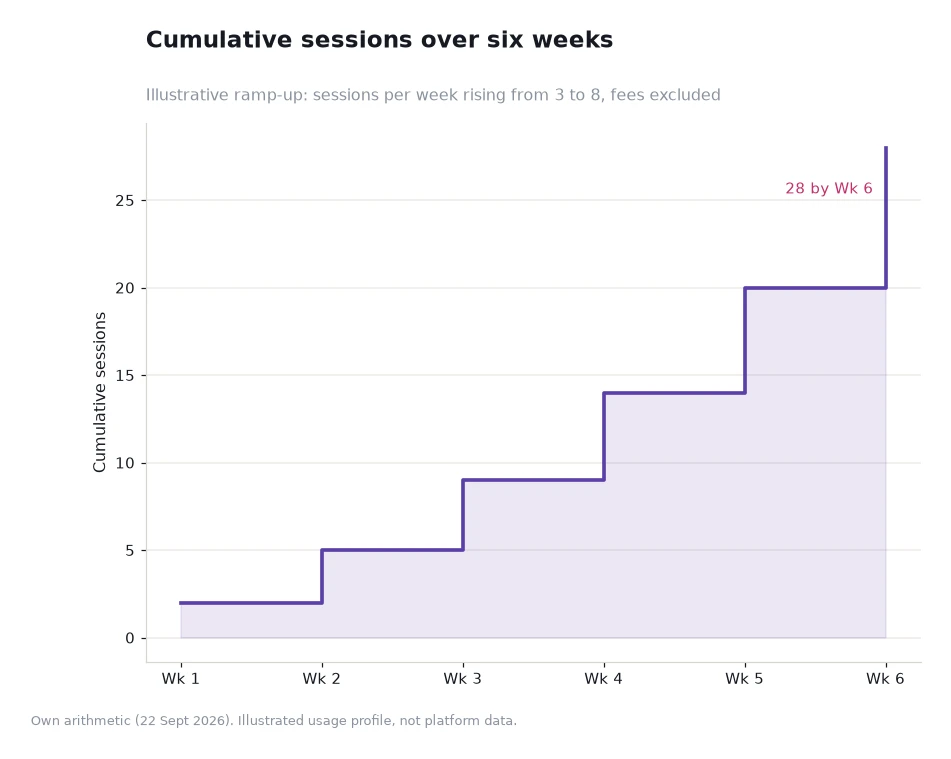
The question worth asking about an adult AI chat habit is not whether it is good or bad but where its hours come from. On the ramp used below, 28 sessions at ten minutes each is 280 minutes, about 4.7 hours across six weeks - small enough that most people could keep it without changing anything else, and large enough that taking those hours from the wrong place would be noticed. The arithmetic is the honesty mechanism.

Key takeaways
- Name the hours before you spend them: 28 sessions at ten minutes is 280 minutes, and the question is which block of your week loses them.
- Fix a window rather than a quota. Two evenings a week is easier to explain and easier to keep than a daily habit.
- Your notifications are other people's problem too. Previews that appear during shared time are the most common flashpoint.
- Fiction stays fiction: by the platform's own statement the content is AI-generated text depicting no real person.
Where the hours come from
Every hobby is paid for in time, and most of the friction around one comes from not naming the account it is drawn on. Adult AI chat is cheap in that respect, which is also why it can expand quietly: 280 minutes over six weeks is 47 minutes a week, roughly a single evening's television, and it does not announce itself the way a night out does.
So the first useful move is to say the number out loud, at least to yourself. Ten minutes a session, two to six sessions a week, is a habit of between one and three hours a month. Written down, it is either obviously fine or obviously too much, and both answers are useful - the confusion only exists while the number stays unnamed.
The second move is to decide which block of the week it comes from. Taking it from solo time is invisible to everyone else; taking it from shared time is not, and the difference between the two is not the size of the habit but its location. A reader who has decided the block in advance never has to negotiate the same question repeatedly, which is the point of deciding at all.
Honesty is cheaper than concealment
Concealment has carrying costs. A habit hidden from someone in the same household has to be scheduled around them, which means it takes the leftover hours, which are exactly the hours people are most tired and least able to enjoy it. That is a bad trade in both directions: the habit gets worse and the concealment needs maintaining.
Honesty is a spectrum rather than a single act, and it does not require an announcement. It can mean simply not hiding: the platform in its own browser profile, the window fixed rather than improvised, the notification previews off so nothing appears on a shared screen. Deciding not to hide is much easier than deciding to explain, and it produces most of the same benefits.
It also helps to be accurate about what the activity is when you think about it privately. By the platform's own statement the content is AI-generated text that depicts no real person and involves no images or video. That is a definition, not a defence: a fictional text conversation is a different thing from a relationship, and treating it as an alternative to one is where the trouble starts. Used as a private diversion with a fixed budget, it does not compete with anything.
| Signal | What it usually means | Cheap correction |
|---|---|---|
| Sessions jump whenever the house is empty | The habit is scheduled around other people rather than by you | Fix a window instead of waiting for an opportunity |
| You check the app during shared evenings | The budget is ambient rather than bounded | Turn previews off and leave the phone in another room |
| Weekly minutes keep rising without a decision | No cap exists, so the habit expands into available time | Set a weekly session count and log it in one line |
| Sessions become the only wind-down you use | One tool is doing the work of several | Keep one other evening routine that is not screen-based |
| You would not want the window visible on a screen | Something about the setup needs changing rather than hiding | Fix the setup: profile, previews, seat, timing |
Worked example: a six-week budget you can state in one line
Use the ramp below, which is illustrative arithmetic: weekly session counts of 2, 3, 4, 5, 6 and 8, accumulating to 28 sessions across six weeks, an average of 4.7 a week. At ten minutes a session that is 280 minutes, or 4.7 hours, which averages 47 minutes a week.
Now locate those minutes. One film-length block a week covers 47 minutes exactly, and so does a shorter amount on four evenings. The comparison is the whole exercise: if the budget fits inside a slot you were already spending alone, nothing else changes. If it does not fit, you have found the actual cost - and it is worth knowing whether the trade is one you would make deliberately.
Then check the other direction, using the message side of the same habit. At 4 messages a day a month is 120; at 18 it is 540; at 60 it is 1,800. A light habit of 120 messages a month is closer to 60 minutes of writing at 30 seconds a message, which is a single hour - a figure small enough to say to anyone. Every number here is an assumption built to make the comparison, not platform data.
Setting it up so it stays small
Three settings do most of the work. Keep the app out of shared notification space, so a message never arrives in a room where it was not invited. Keep the habit in its own browser profile if the device is shared, which removes accidental visibility without requiring secrecy. And keep the session count written down somewhere you will see it monthly, because a habit with a number attached is far harder to inflate by accident.
Then use the browsing tools with the same restraint. A weekly rhythm suits this kind of use better than a daily one, and the NSFW AI trends shelf is arranged that way, with a fixed set of cards and counters that make a quick choice possible. If you want to be deliberate about the terms of your own use, the Crushon AI chat blog covers setup and usage topics, and the Crushon page for porn ai chat describes what the activity is in plain terms - its FAQ uses the term Porn Chat AI, and both are more useful when you would rather know than speculate.
Finally, keep one thing that is not this. A second wind-down routine, a hobby that involves other people, or simply a rule that the last half hour of the evening belongs to something else - any of those keeps the habit in the role you assigned it. The test is not how much time it takes but whether the rest of your week looks the same as before you started.
Frequently asked questions
How much time does a typical habit take?
On an illustrative 28-session ramp at ten minutes a session, 280 minutes across six weeks - about 47 minutes a week, or one evening a month at three hours.
Should I tell my partner about it?
That is a personal call, but concealment has costs. Deciding not to hide it - separate profile, previews off, a fixed window - captures most of the benefit without requiring an announcement.
Is AI chat a substitute for a relationship?
No. By the platform's own statement the content is AI-generated text depicting no real person, and it involves no images or video. Treated as a private diversion with a fixed budget, it competes with nothing.
Write the number, then keep it small
Log your sessions for two weeks, convert them to minutes, and state the weekly figure in one sentence you would be comfortable repeating. If it fits inside a block of time you already spend alone, keep it there and check the number again next month. If it does not fit, cut the session count rather than the sleep, and turn the notification previews off today - the smallest habit is the one easiest to keep in its place.
Data: platform statement wording and trending shelf counters, read 22 Sept 2026[1]. Session counts, minutes and message volumes are own arithmetic presented as an illustrative profile, not platform data. This article is for adults aged 18 and over.